Understanding Leather Watch Straps: Materials, Classification and Construction
Leather is one of the most established materials used in watch strap manufacturing. Its flexibility, strength, surface texture and finishing possibilities make it suitable for a broad range of watches. However, leather is not a single material with uniform characteristics: its properties depend on the animal skin, processing and finished strap construction.
The terminology used to describe leather is often misunderstood. In particular, full-grain, top-grain, split, genuine and bonded leather do not form a universally recognised five-level quality ranking. The distinctions below explain what each description does—and does not—establish.
What Is Leather?
Leather is produced by tanning animal hides or skins while substantially preserving their original collagen-fibre structure. Tanning stabilises the material against decomposition and makes it suitable for manufacturing. The structure and integrity of the fibres distinguish intact-hide leather from materials made by bonding leather fragments together.
Understanding the Structure of a Hide
The grain-bearing outer region of a hide generally has a relatively compact collagen-fibre structure; deeper regions tend to be more open. A splitting machine can divide a thick hide into a grain split, which retains the original grain surface, and one or more lower splits, which do not. Fibre density also varies by animal and by location on the hide.
Leather Classification: Full-Grain, Top-Grain and Split
Full-Grain and Top-Grain Leather
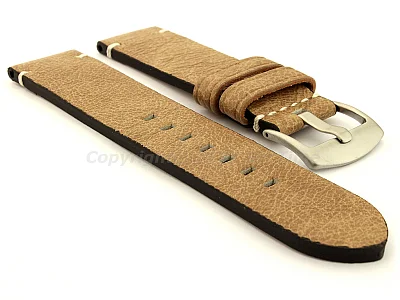
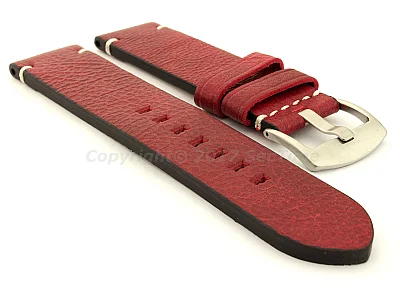
Full-grain leather preserves the natural grain surface, so variations in pores, texture and markings may remain visible. “Top-grain” can refer broadly to leather from the grain-bearing upper section, but retail usage sometimes applies the term to leather with a corrected surface. The two terms should therefore not automatically be treated as mutually exclusive.
Corrected-Grain and Split Leather
Corrected-grain leather is mechanically treated to reduce surface irregularities and may receive a finish or embossed pattern. Split leather comes from below the grain layer; it can be used for suede or finished to create a more uniform surface. The underlying leather, finishing system and intended application determine suitability.
Genuine Leather and Bonded Leather
“Genuine leather” indicates authenticity rather than a particular quality grade. Bonded leather, by contrast, is manufactured from leather fibres or fragments held together by binders and does not retain the continuous structure of intact hide. Split leather and bonded leather are fundamentally different constructions.
How Leather Is Tanned
Tanning stabilises collagen fibres. The final feel of leather also depends on subsequent processes such as dyeing, lubrication, drying and finishing.
Neither vegetable nor chrome tanning is automatically superior. Material quality, appropriate processing and intended use matter more than a tanning label in isolation.
Leather Finishes and Surface Treatments
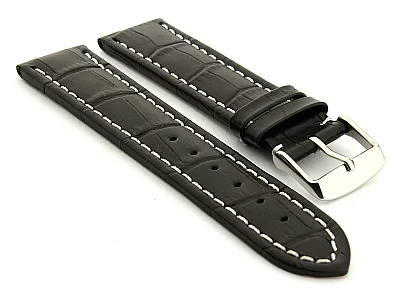
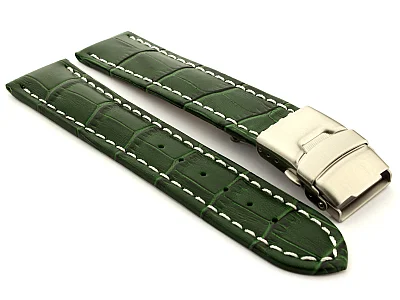
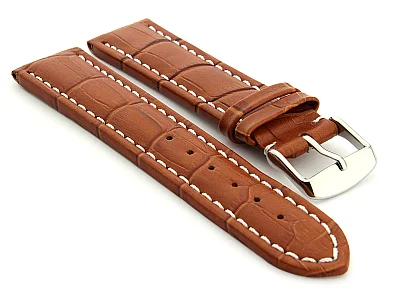
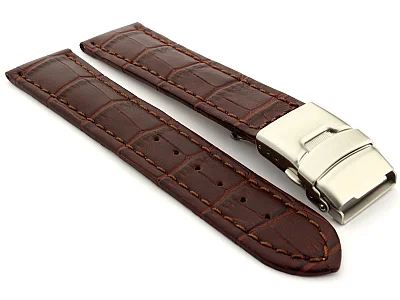
For example, crocodile-pattern calf leather can resemble genuine crocodile skin without coming from a crocodile. The description of a surface pattern must be distinguished from the animal source.
Animal Sources Used for Leather Watch Straps
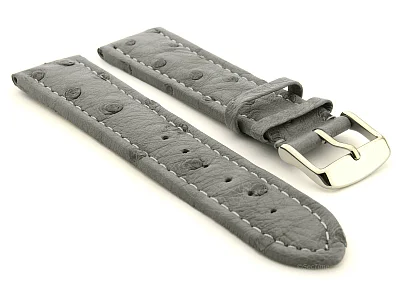
Species influences natural grain, scale pattern, thickness and texture, but leather from the same species can vary by hide section, processing and finish. The following categories illustrate the range of animal-derived leathers used in watch straps.
Animal identity and trade compliance are separate considerations. Certain exotic species may be subject to sourcing, documentation or international trade requirements. An embossed imitation of an exotic pattern should not be described as leather from that species.
Leather Watch Strap Construction
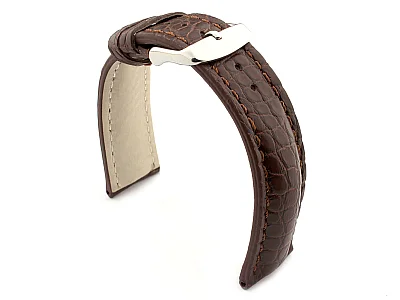
A finished strap may combine an outer leather, lining, internal reinforcement, padding, stitching and edge finishing. The properties of the finished product depend on how these components work together—not simply on the name of the outer leather.
Flat, Padded and Perforated Designs
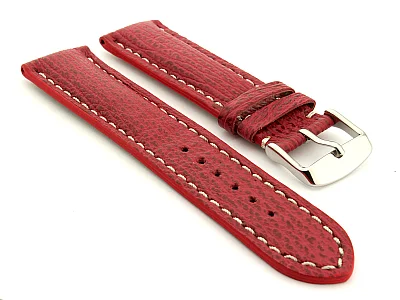
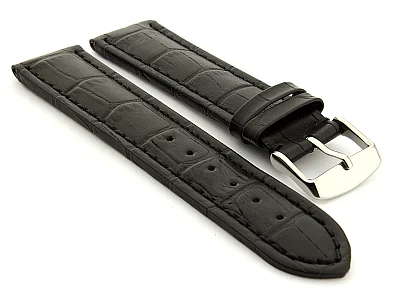
Flat straps tend to have a restrained profile, whereas padded watch straps incorporate material that creates a raised profile, often near the case. Padding alone is not a measure of strength. Perforated watch straps use openings as a design feature and may affect ventilation; their suitability still depends on leather and construction.
Attachment and Strap Configuration
Traditional two-piece straps attach separately to each side of the watch. Leather NATO straps use a different, continuous-strap configuration. Watches with fixed attachment bars may require open-ended watch straps or another compatible construction. Fit must account for lug geometry, bar type, strap thickness and clearance—not just nominal width.
Sizing and Fit of Leather Watch Straps
Watch-end width should match the distance between the inner faces of the watch lugs. Common examples include 18mm leather watch straps, 20mm leather watch straps and 22mm leather watch straps. Other sizes, including 24mm leather watch straps, are available for compatible watches.
Length is a separate measurement from width. Strap sections, hole spacing, watch case dimensions and wrist circumference all affect fit. Extra-long leather watch straps may suit some larger wrists, but their dimensions should be checked rather than assumed.
How Leather Changes with Age and Wear
Repeated bending, friction, skin oils, light and moisture can alter a leather strap. Some finishes develop a visible patina; others retain a more uniform surface or show wear differently. Creasing may be normal, but cracking, layer separation or damaged attachment points can indicate deterioration.
Leather can absorb moisture, and perspiration may affect linings, finishes and adhesives. A surface treatment that resists occasional moisture does not necessarily make the whole strap waterproof.
Leather Care and Maintenance
Conditioning is not universally suitable: some finishes and coatings can be harmed by inappropriate products. Follow manufacturer instructions. Replace a strap when cracking, loose structural stitching, separation, excessive hole wear or damaged fittings compromise secure attachment.
Evaluating Leather Watch Strap Quality
A label such as “genuine calf leather” identifies real leather and its animal source, but does not by itself specify full-grain status, tanning method or construction quality. Likewise, a crocodile-pattern finish does not establish crocodile origin. Precise descriptions are more informative than broad claims of “premium” quality.
Understanding the Finished Leather Strap
The most reliable way to evaluate a leather watch strap is to consider the animal source, hide structure, tanning, finish, construction and intended use together. No single grade or marketing term captures all of these characteristics. Understanding the distinctions makes it easier to select a strap that fits securely, feels appropriate on the wrist and suits the watch.