NATO watch straps use a one-piece construction and are available at Sectime in nylon, leather and selected synthetic materials, with a wide choice of colours, patterns and hardware styles. The range covers common watch widths and several overall strap lengths, including classic military-inspired and more contemporary designs. For an iconic striped look, explore our Bond-inspired NATO watch straps, featuring classic black and grey stripes and vintage-inspired colour combinations.
Because a NATO strap passes beneath the watch, confirm the lug width and check that there is suitable clearance around the fitting points. Compare material, overall length, ring arrangement and hardware finish on the individual product page to find the most suitable combination for your watch.
No. The range also includes leather and selected other materials.
Confirm lug width and make sure the watch has suitable clearance for the one-piece strap to pass beneath it.
Measure the lug spacing and choose a NATO strap with the same watch-end width.
Yes. The range includes plain colours, stripes and contrasting military-inspired designs.
Its one-piece construction passes beneath the watch rather than attaching as two separate strap halves.
Understanding NATO Watch Straps: History, Construction, Materials and Design
A NATO watch strap is a pass-through design in which a continuous length of material runs behind the watch case and through its attachment points. The familiar military-style version is associated with British equipment specifications and is commonly called a G10 strap. Modern NATO watch straps include several constructions and textiles, so the name alone does not establish an exact specification.
This guide explains the design’s origins, the historical drawing reproduced below, the difference between NATO and conventional two-piece straps, and the characteristics of standard woven, ribbed, seatbelt-style and ballistic nylon.
1. What Makes a Strap a NATO Strap?
A conventional NATO-style strap passes behind both spring bars or fixed bars rather than attaching as two independent pieces. The traditional G10 arrangement includes a second, shorter retaining section through which the main strap is threaded. This additional section helps restrict the watch’s movement along the webbing.
Component
Purpose
Main webbing
Passes behind the watch and around the wrist.
Secondary retaining section
Helps hold the watch in position on a traditional G10 configuration.
Buckle
Fastens the strap around the wrist.
Metal keepers or loops
Control the loose end and guide the webbing.
Sealed or finished tip
Helps prevent fraying at the free end.
Joined or reinforced folds
Hold the hardware and retaining section in place.
A single-pass strap has no secondary retaining section. It may be sold as NATO-style, but it is not identical to the traditional double-pass G10 construction.
2. British Military Origins and the G10 Name
Nylon pass-through watch straps are associated with British military supply requirements. Earlier military watches also used leather and textile straps, and the general idea of passing a strap behind a watch predates the familiar 1970s G10 design.
Historical discussions commonly identify Defence Standard 66-4 from 1968, Defence Standard 66-15 from 1973, and later Defence Standard 66-47 documents. These represent stages in specification development; 1973 should not be presented as the date on which all pass-through watch straps were first invented.
The nickname “G10” is generally linked to British military G1098 equipment requisition paperwork. The commercial name “NATO strap” is associated with military supply identification, including the NATO Stock Number system. Neither term means that a modern retail strap is necessarily certified to a military standard.
Historical reference
Why it matters
1968 — Defence Standard 66-4
An earlier documented British nylon wristwatch strap specification.
1973 — Defence Standard 66-15
A frequently cited specification associated with the classic G10 history.
1992 — Defence Standard 66-47
A later stage in the documented specification history.
Defence Standard 66-47/2
The issue identified on the historical technical drawing reproduced below.
Military specification details changed between issues. Measurements from one drawing should not be retroactively attributed to every earlier strap.
3. Historical Technical Drawing: Defence Standard 66-47/2
The following technical illustration is labelled DEF STAN 66-47/2. It depicts a specified nylon wristwatch strap, including the secondary retaining section, buckle, loops, hole positions and finishing requirements.
Figure 1. Nylon wristwatch strap drawing from Defence Standard 66-47/2. The dimensions and materials shown describe this specification issue, not every NATO strap.
Feature
Detail shown on the drawing
Overall length
280 mm
Nominal width
20 ± 0.5 mm
Thickness
1.2 mm
Strap material
Woven nylon, straight cross weave
Joints
Welded
Colour
Admiralty Grey, BS 4800 Card 3, reference 18B25
Buckle and loops
Chromium-plated brass
Buckle detail
Recessed to secure the prong
Free end
End of strap to be sealed
The drawing is particularly useful for describing straight cross-woven nylon as a historical construction. “Plain-weave nylon” may be used in broader textile discussions, but the wording visible on this drawing is “straight cross weave”. Its 280 mm length and 20 mm nominal width are not universal dimensions for all military or commercial NATO straps.
The illustration also helps distinguish historical specification requirements from modern choices such as black-coated hardware, coloured webbing and alternative ring arrangements.
4. Traditional Two-Piece Straps Compared with NATO Straps
The most important distinction between a traditional two-piece watch strap and a NATO strap is the route by which the strap attaches to the watch.
Characteristic
Traditional two-piece strap
NATO or pass-through strap
Construction
Two separate sections attached on opposite sides of the case.
Continuous material passes beneath the case.
Attachment security
Failure of one attachment point may release the watch.
If one attachment point fails, the other may still retain the watch.
Case-back contact
The case back usually touches the wrist.
Material separates the case back from the wrist.
Added height
No strap layer normally passes beneath the case.
One or more material layers increase effective case height.
Replacement
Usually requires removing spring bars, unless quick-release fittings are used.
Often threads through existing bars without removal.
Fixed bars
Requires an appropriate specialist or open-ended design.
Many pass-through straps can fit fixed bars if clearance allows.
Adjustment
Typically uses buckle holes in one of two sections.
Usually fastens along a continuous length.
Compatibility
Depends on attachment style and lug width.
Depends on lug width, available clearance and material thickness.
Attachment Redundancy
The pass-through route offers a practical advantage: if one spring bar becomes detached while the other remains secure, the strap may still retain the watch. This is a conditional advantage, not a guarantee. Worn spring bars, damaged lugs or failed buckles can still cause loss.
Case Height and Wearing Position
NATO webbing lies between the watch and the wrist. A traditional double-pass design may place more material under the case than a single-pass strap. The result can be a noticeably higher wearing position, especially on an already thick watch.
Fitting and Fixed Bars
A pass-through strap can be useful for watches with fixed attachment bars. Other watch straps for fixed lugs use different constructions, including open-ended designs. In either case, the material must fit through the available space without forcing the strap against the case or bars.
5. Four Important Nylon Materials and Weaves
The term “nylon NATO strap” covers textiles with different surfaces, densities and finishes. The four material descriptions below are useful for comparing products, but they are not all standardised performance grades. Actual strength and flexibility depend on the individual webbing and its manufacture.
Material
Typical surface
Common character
Terminology caution
Standard woven nylon
Conventional woven textile surface.
Traditional, functional NATO appearance.
The exact weave should be stated only when known.
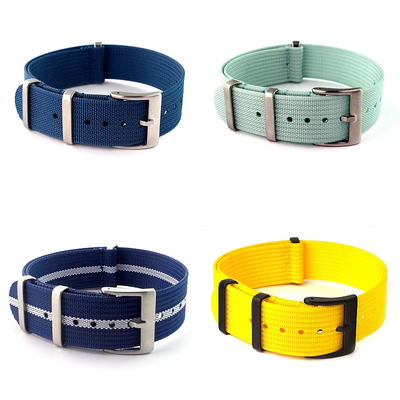
Ribbed nylon
Raised linear or ribbed texture.
Distinctive textured appearance.
Ribbing does not automatically mean greater strength.
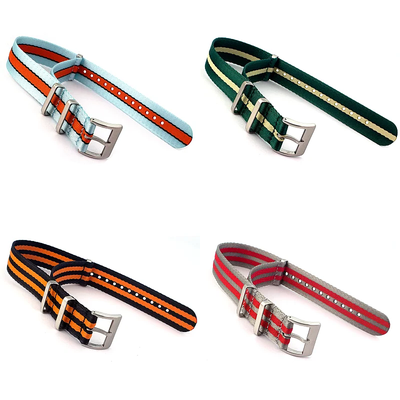
Seatbelt-style nylon
Fine, smooth weave, often with a slight sheen.
Frequently supple and smooth against the wrist.
Does not imply automotive seatbelt certification.
Ballistic nylon
Often dense, substantial woven surface.
Usually marketed as robust or heavy-duty.
The label alone does not specify denier, weave or tensile strength.
Standard Woven Nylon
Standard woven nylon is an appropriate general description for conventional NATO webbing when no more precise textile specification is supplied. Traditional military-inspired versions often have a straightforward cross-woven appearance. The historical drawing above explicitly specifies woven nylon with a straight cross weave.
Ribbed Nylon
Ribbed nylon has visible longitudinal or other raised texture created by its weave structure. The texture changes the appearance and feel, but thickness, stiffness and abrasion behaviour still vary by manufacturer. Nylon watch straps also include non-NATO constructions, so the material and strap layout should be assessed separately.
Seatbelt-Style Nylon
Seatbelt-style nylon usually refers to fine, smooth webbing that resembles the finish of automotive restraint fabric. It may be more supple than conventional webbing, although that is not guaranteed. The description is visual and tactile: it does not mean the strap meets vehicle safety standards.
Ballistic Nylon
Ballistic nylon originated as a term associated with robust woven nylon fabrics used in protective military applications. In contemporary retail use it may describe heavy-duty webbing, but it is not by itself proof of a particular denier, tensile strength, military approval or weave. Product-specific measurements are more useful than the label alone.
Material Is Not the Same as Configuration
Any of these webbing descriptions may be combined with different strap arrangements. A ribbed strap may have a secondary keeper or a single-pass layout; a seatbelt-style strap may use different buckle and ring patterns. Textile type and finished construction should therefore be compared independently.
6. NATO Strap Configurations and Modern Variants
Configuration
Typical arrangement
Practical implication
Traditional G10 / double-pass
Main strap plus secondary retaining section.
Helps control case position but can add bulk beneath the watch.
Single-pass
One continuous section with no secondary retaining section.
Generally less material beneath the case.
RAF-style
Military-inspired pass-through design; details vary by maker.
Check the actual threading arrangement rather than the name.
Zulu-style
Often thicker webbing with substantial rounded hardware.
Commercial terminology is not completely consistent.
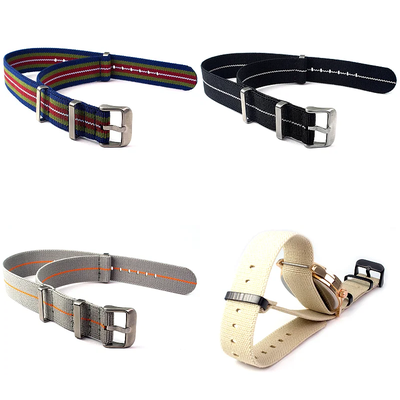
Allows stretch but behaves differently from traditional non-elastic webbing.
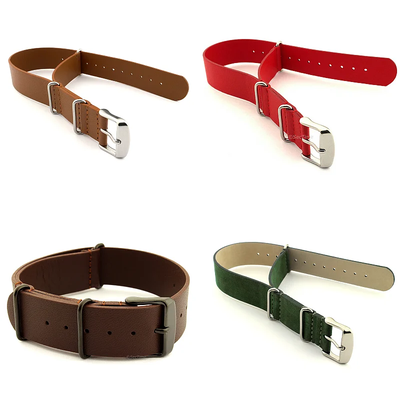
Leather NATO-style
Pass-through arrangement made with leather.
Different flexibility, moisture response and maintenance needs.
A leather NATO strap preserves the general pass-through principle but does not have the same material behaviour as nylon. Readers interested in hide types and finishes can consult the wider leather watch straps guide.
The number of rings is not a reliable standalone test of whether a strap matches an original military issue. Hardware shape, retaining section, material and dimensions all matter.
7. Buckles, Rings, Joints and Edge Finishing
A NATO strap is a complete assembly rather than merely a strip of nylon. Its buckle, loops, attachment folds and free-end finishing are essential to how it functions.
Feature
Technical consideration
Buckle
Should operate securely and suit the strap’s thickness.
Keepers and rings
Their number, position and shape affect how excess webbing is retained.
Metal specification
Stainless steel and plated brass are different materials and should not be conflated.
PVD coating
A surface coating process, not a base-metal type.
Stitched or welded joints
Integrity depends on the method and execution of the joint.
Heat-sealed edges
May reduce fraying on suitable synthetic webbing.
Strap tip
Should be cleanly finished and pass through the buckle and keepers.
The 66-47/2 drawing specifically calls for chromium-plated brass hardware, welded joints and a sealed end. Modern products may use stainless steel, coated hardware, stitching or other construction methods without claiming to reproduce that specification.
8. Width, Length, Thickness and Watch Compatibility
Width
Measure the clear distance between the inner faces of the watch lugs. NATO watch straps are available in 16mm, 18mm, 19mm, 20mm, 21mm, 22mm, 24mm and 26mm widths. For example, a 20mm lug spacing normally requires a 20mm strap. Avoid forcing an oversized strap between the lugs.
Overall Length
NATO length is generally measured along the continuous strap, not as two separate pieces. Check the individual product’s stated dimensions: the watch case consumes some length, and the remaining free end must reach the buckle and keepers comfortably. The 280 mm measurement in the historical drawing is a specification detail, not a required length for every wrist.
Thickness and Clearance
Thickness is especially important because the strap must pass between the case and the spring bars or fixed bars. Two straps of identical width may fit differently if their thickness or stiffness differs. Double-pass construction can add more material beneath the case than single-pass construction.
Measurement
How to check it
Why it matters
Lug width
Measure the inside distance between the lugs.
Determines nominal strap width.
Strap length
Compare the product’s overall length with wrist and case dimensions.
Determines fastening range and excess tail.
Webbing thickness
Check the stated thickness and available bar-to-case clearance.
Determines whether the strap can pass under the watch.
Hardware dimensions
Check buckle and keeper profile if clearance or comfort is limited.
Can affect fit and ease of use.
9. How to Fit a NATO Strap
Measure the watch’s lug width and confirm the strap width.
Inspect the spring bars or fixed bars for damage and secure seating.
Check that there is sufficient clearance for the webbing beneath the case.
Thread the long section of the strap through one attachment point, behind the watch, and through the other.
For a traditional double-pass NATO, feed the main section through the secondary retaining loop and position the watch.
Fasten the buckle around the wrist and secure the remaining tail through the keepers.
Check the strap’s alignment and the security of both watch attachment points.
The threading direction and precise order may differ between strap configurations. Never force thick or stiff webbing through a tight opening. If the bars or lugs are damaged, correct that problem before wearing the watch.
10. Advantages and Limitations in Everyday Use
Aspect
Potential advantage
Important limitation
Security
Continuous material can provide attachment redundancy.
Does not prevent loss if the remaining attachment or fastening fails.
Convenience
Often changed without removing spring bars.
Some watches lack sufficient clearance.
Comfort
Textile sits between the case back and skin.
Additional layers may raise the watch.
Moisture
Many nylon constructions tolerate routine wetting.
Dense webbing may take time to dry.
Appearance
Different weaves, colours and hardware create varied finishes.
Material names alone do not predict quality.
Sizing
Continuous strap offers a broad adjustment range.
Excess tail and overall length must suit the wearer.
For a comparison with other strap constructions and materials, see the broader watch strap guide.
11. Cleaning and Maintenance
Care requirements vary with fibre blends, finishes, hardware and joint construction. For many nylon straps, gentle cleaning with mild soap and lukewarm water is appropriate, followed by thorough rinsing and air drying. Follow any more specific manufacturer instructions.
Material
General care approach
Avoid
Standard woven nylon
Gently clean and allow to dry completely.
Excessive heat and aggressive chemicals.
Ribbed nylon
Clean carefully along textured areas.
Harsh abrasion that damages raised fibres.
Seatbelt-style nylon
Use mild cleaning suited to the finish.
Rough scrubbing that changes the smooth surface.
Ballistic nylon
Follow the actual product’s care instructions.
Assuming every heavy-duty textile has the same coating or wash tolerance.
Elastic blends
Clean gently and air dry.
Conditions that degrade elastic components.
Leather
Use leather-specific care appropriate to its finish.
Prolonged soaking unless specifically permitted.
Inspect the strap periodically for fraying, weakened joints, stretched holes, bent keepers and buckle damage. Also inspect the spring bars and watch lugs. A strap that can no longer retain the watch securely should be replaced.
12. Evaluating NATO Strap Quality
Terms such as “military-style”, “premium nylon” and “ballistic” are not substitutes for verifiable product specifications. A meaningful assessment considers the webbing, construction, hardware and compatibility together.
Factor
What to establish
Material
Actual fibre composition and any relevant coating or blend.
Weave and finish
Surface texture, density, flexibility and edge quality.
Configuration
Double-pass, single-pass or another stated layout.
Dimensions
Width, length and thickness appropriate to the watch and wrist.
Hardware
Buckle, keepers, material and coating.
Joints
Condition of stitching, welding or other assembly methods.
Historical claims
Whether a military-standard claim identifies a specific document and issue.
A modern NATO strap need not reproduce a military issue to be suitable for everyday use. The important question is whether its specifications and construction match the watch and intended conditions.
Conclusion
NATO straps combine a recognisable pass-through design with a broad range of modern materials and constructions. The British Defence Standard drawing provides a precise historical example of woven nylon, dimensions and hardware, but it should not be mistaken for a universal definition of every NATO strap sold today.
For a reliable comparison, distinguish the traditional G10 double-pass arrangement from other pass-through designs, and compare standard woven, ribbed, seatbelt-style and ballistic nylon by their actual construction rather than by their names alone.



 Leather NATO Watch Straps
 Ribbed NATO Watch Straps
 Seatbelt NATO Watch Straps
 Elastic NATO Watch Straps
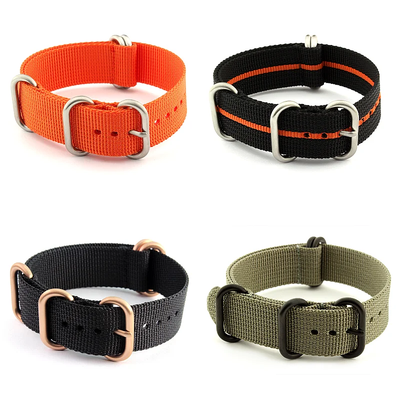 Zulu Watch Straps
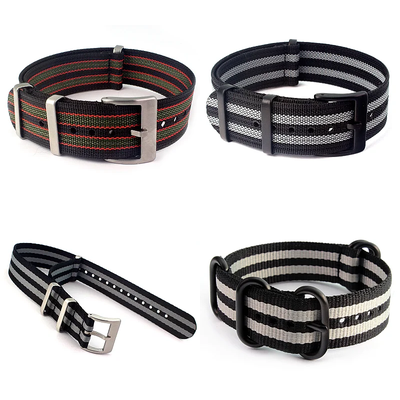 Bond-Inspired NATO Watch Straps
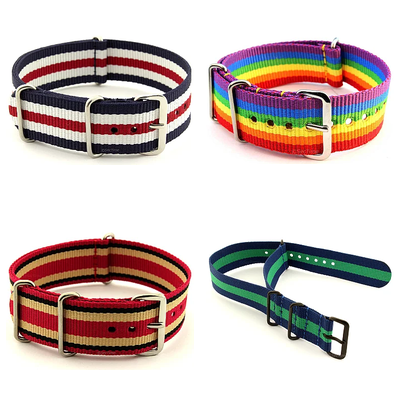 Classic NATO Watch Straps


