Quick release watch straps feature spring bars with a small integrated lever, allowing the strap to be removed and replaced without a traditional spring-bar tool. They offer a convenient solution for changing straps while retaining the familiar two-piece watch strap construction.
Our collection includes leather, nylon, silicone, FKM rubber and alternative materials in a wide selection of colours, textures and finishes. Choose from slim and padded designs, traditional buckles, deployment clasps and hook-and-loop fastenings.
Quick release straps are available in a broad range of widths, including popular 18mm, 20mm, 22mm and 24mm sizes. For a secure fit, match the strap width to the distance between your watch lugs and check that the quick-release mechanism is compatible with your watch.
Understanding Quick Release Watch Straps: Mechanism, Installation and Compatibility
Quick-release watch straps use a modified spring-bar attachment that allows the strap to be removed without a separate spring-bar tool. The mechanism incorporates a small external lever connected to a retractable spring-loaded pin.
The principle is similar to that of a conventional spring bar: two opposing ends engage with holes in the watch lugs. The difference is how one end of the bar is retracted during installation or removal.
Quick-release fittings are commonly incorporated into two-piece watch straps. They change the method of attachment without fundamentally changing the strap’s construction, fastening system or material.
1. How a Quick-Release Spring Bar Works
A conventional spring bar consists of a hollow metal tube containing spring-loaded components. When correctly installed, its projecting ends engage with the corresponding holes inside the watch lugs.
A quick-release spring bar uses the same general retention principle but adds a small lever, usually accessible from the underside of the strap. Moving this lever retracts one of the spring-loaded ends into the bar. Releasing it allows the spring to extend the pin again.
The mechanism therefore provides a way to operate the spring bar directly, without inserting a separate tool between the strap and watch case.
Main Components
Component
Function
Spring-bar body
Houses the internal spring mechanism
Fixed or non-lever-operated end
Engages with one watch lug
Retractable end
Moves inward when the lever is operated
Internal spring
Returns the retractable end towards its extended position
External lever
Allows manual retraction of the pin
Strap-end opening
Provides access to the lever from the underside of the strap
The precise internal construction may vary between manufacturers. What defines the quick-release arrangement is the accessible lever used to retract the spring-loaded attachment.
2. Classic Spring Bars Compared with Quick-Release Spring Bars
The principal difference between the two systems is the method used to retract the spring-loaded pin. Both rely on properly sized spring bars engaging securely with the watch lugs.
Visual Comparison
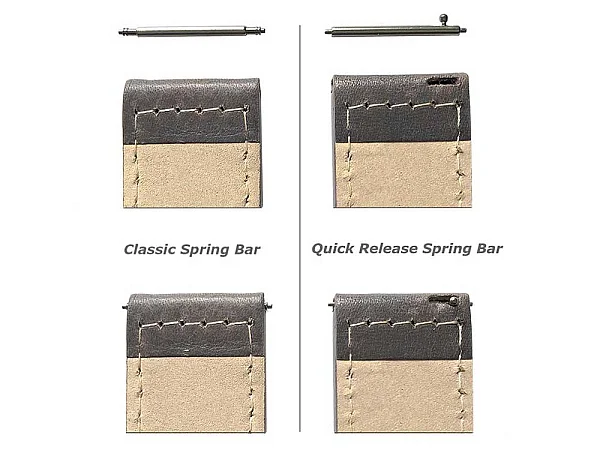
Classic and quick-release spring bars. The quick-release version incorporates an accessible lever that retracts one end of the spring bar.
The illustration shows the distinction both before installation and when the bars are fitted into the ends of a leather strap. On the quick-release version, the lever projects through a small opening in the strap. This allows the wearer to operate the mechanism while the spring bar remains fitted inside the strap.
Functional Comparison
Characteristic
Classic Spring Bar
Quick-Release Spring Bar
Retention principle
Spring-loaded ends engage with the watch lugs
Spring-loaded ends engage with the watch lugs
Pin retraction
Normally operated using a spring-bar tool
Operated using an integrated lever
Strap removal
Usually requires a separate tool
Usually possible without a separate tool
Strap installation
Spring bar is compressed during fitting
Lever retracts one end during fitting
Access point
Typically between the strap and watch lug
Usually on the underside of the strap
Strap construction
Compatible with suitable conventional strap ends
Requires a strap end designed to accommodate the lever
Attachment security
Depends on correct sizing, installation and condition
Depends on correct sizing, installation and condition
Maintenance
Inspect for wear, bending and spring failure
Inspect the same components, including lever operation
Quick-release does not mean that the strap is held by a fundamentally different type of connection. Both systems depend on the engagement of spring-loaded pins with the watch case. The quick-release lever changes how the pin is operated, not the basic attachment principle.
3. Installing and Removing a Quick-Release Watch Strap
Quick-release straps are designed to simplify routine replacement, but correct installation remains essential. The lever should move freely, and both spring-bar ends must engage properly with the watch lugs.
Installation
Confirm that the strap width matches the watch’s lug spacing.
Identify the underside of the strap and locate the quick-release lever.
Position the non-retracting end of the spring bar in one lug hole.
Move the lever to retract the opposite end.
Guide the retracted end between the lugs and align it with the second lug hole.
Release the lever so that the pin extends into the hole.
Check that both ends are seated securely before wearing the watch.
Removal
Place the watch on a clean, stable surface.
Locate the quick-release lever on the underside of the strap.
Move the lever to retract the spring-loaded pin.
Carefully lift the released end away from the lug.
Withdraw the opposite end from its hole.
Repeat the procedure for the second strap section.
The mechanism should operate without excessive force. If the lever is difficult to move, the bar appears damaged or the strap cannot be positioned correctly, the fitting should be inspected rather than forced.
Installation and Removal Video
The installation video provided on this category page demonstrates the operation of the quick-release lever and the procedure for fitting and removing a strap. The key point to observe is the movement of the retractable pin: the lever is held while the strap is positioned, then released once the pin is aligned with the lug hole.
After installation, both attachment points should be checked manually. A spring bar that appears to be in position may not be fully seated.
4. Compatibility: Which Watches Accept Quick-Release Straps?
Quick-release straps are widely used with watches that have conventional lugs and removable spring bars. However, matching the nominal strap width is necessary but not always sufficient. Compatibility depends on the dimensions and geometry of the attachment system.
Lug Width
The strap’s watch-end width should correspond to the distance between the inner faces of the watch lugs. For example, a watch with a 20mm lug spacing normally requires a 20mm strap. An incorrect width can interfere with installation or prevent the spring bar from engaging as intended.
Spring-Bar Dimensions
Spring bars can differ in overall length, tube diameter, pin diameter and end shape. A quick-release bar must be suitable for the watch’s lug holes and the strap construction. Two spring bars described by the same nominal strap width are not necessarily identical in every dimension.
Lever Clearance
The lever must remain accessible without pressing against the watch case. On some watches, the shape of the lugs or case back can restrict access or interfere with the lever. This is particularly relevant where the attachment area is recessed or unusually narrow.
Curved and Integrated Attachments
Some watches have curved, recessed or proprietary strap connections. A conventional straight-ended quick-release strap may not fit these arrangements even when its nominal width matches the watch. Similarly, watches with fixed bars generally cannot accept a standard two-piece quick-release strap because the bar cannot be removed to fit the strap section.
Watch attachment
General compatibility consideration
Conventional lugs with removable spring bars
Commonly suitable when dimensions match
Narrow or recessed lug openings
Lever clearance must be checked
Curved or shaped strap fittings
Requires a compatible strap-end design
Fixed bars
Generally unsuitable for conventional two-piece quick-release fittings
Integrated or proprietary connections
Requires a specifically compatible attachment system
5. Practical Advantages and Limitations
The principal advantage of quick-release construction is convenience when changing a strap. The mechanism can also reduce the need to position a metal spring-bar tool close to the watch case during routine strap replacement. However, this does not make the attachment maintenance-free or eliminate the possibility of damage.
Aspect
Practical advantage
Limitation
Strap replacement
No separate spring-bar tool is normally needed
The lever must remain accessible and functional
Installation
Direct control of the retractable pin
Both ends still require correct alignment
Watch-case handling
Less need to insert a tool near the lugs
Careless fitting can still scratch the case
Strap interchangeability
Convenient for watches with compatible fittings
Not all watches use compatible spring bars
Retention
Uses the established spring-bar attachment principle
Security still depends on correct installation and component condition
Quick-release construction should not be interpreted as an inherently stronger or weaker attachment than a conventional spring bar. Such a comparison would require information about the specific bars, their materials, dimensions, manufacturing quality and condition.
6. Evaluating a Quick-Release Watch Strap
A suitable quick-release strap should be assessed as a complete assembly rather than by the presence of the lever alone. The most important considerations are the compatibility of the spring bar, the operation of the mechanism, the security of the attachment and the construction of the strap itself.
Evaluation factor
What to check
Lug width
Correct nominal width for the watch
Spring-bar fit
Suitable length and pin dimensions
Lever operation
Smooth movement and reliable spring return
Clearance
No interference with the watch case or lugs
Strap-end construction
Properly finished opening and secure bar retention
Material
Appropriate for the intended conditions of use
Installation
Both pins fully engaged before wearing
Conclusion
Quick-release watch straps retain the familiar spring-bar attachment principle while introducing a manually operated lever for easier strap changes. Their value lies in simplifying installation and removal, not in replacing the need for correctly sized components or secure attachment. Understanding the mechanism, its compatibility requirements and its limitations makes it possible to distinguish genuine functional advantages from assumptions based solely on the term quick-release.